Introduction
Ever installed a new gate lock, only to have it jam solid after the first cold snap or heavy rain? You’re not alone — it happens more often than most homeowners expect. A weatherproof smart lock for outdoor gate use is built differently from standard indoor hardware, and knowing what actually makes one reliable can save you from a costly repeat installation. This guide walks through the features, ratings, and care that matter most.
Table of Contents
Why Smart Locks Fail on Outdoor Gates
Most smart locks fail on outdoor gates because they’re built for doors, not open-air exposure — a single-sided seal that protects the outer keypad but leaves the interior wiring, motor, and battery compartment exposed to rain, frost, and humidity from the unprotected back panel.
This is the part most homeowners never think about until it’s too late. A front door lock sits inside a frame, tucked behind a storm door or overhang, with only its outer face ever touching weather. Bolt that same hardware onto a fence or driveway gate, and now both sides face the sky. There’s no porch roof, no interior hallway — just open air hitting the lock from every direction, all day, every day.
We’ve heard this exact complaint from property owners more times than we can count: a new keypad lock goes up in spring, works fine for a few weeks, then locks up solid after the first real cold snap or seizes completely after one heavy downpour. It’s rarely a manufacturing defect. It’s a mismatch between indoor-rated hardware and an outdoor job.
Here’s what actually happens once weather gets inside:
- Water creeps into the back housing during wind-driven rain, shorting the circuit board from behind — the side nobody thinks is weatherproof.
- Morning dew and frost work into the gears overnight, then freeze solid by dawn, jamming the bolt before anyone’s even had coffee.
- Humidity and pool chemicals slowly corrode the internal contacts, especially on gates near backyard pools or coastal properties with salt in the air.
- Cold-weather battery drain hits fast — a standard alkaline battery that lasts a year indoors can die in a matter of weeks once temperatures drop below freezing.
We’ve seen every version of this play out: a driveway gate frozen shut during the first snowfall of the season, a pool gate fingerprint scanner gone unresponsive from chlorine exposure, a farm gate keypad dead three weeks after installation because nobody expected sub-zero nights to drain it that fast. If a jammed mechanism sounds familiar, our guide on what to do when a door lock is stuck in the locked position walks through the same kind of fix.
The pattern is always the same — the lock wasn’t designed to survive being exposed from every angle, and a gate offers no shelter to hide behind. That’s really the whole issue in one sentence: outdoor gates need hardware engineered for total exposure, not adapted from something meant for a doorway. Understanding this failure point also makes it much easier to evaluate IP ratings properly, since that number is really just a measure of how well a lock resists exactly these conditions.
Critical Features Every Weatherproof Smart Lock for Outdoor Gate Must Have
A true weatherproof smart lock for outdoor gate use needs five non-negotiable features: a genuine IP67 or IP68 rating, double-sided access control, corrosion-resistant materials, cold-tolerant battery performance, and reliable smart home connectivity.
Skip any one of these, and the lock is really just indoor hardware wearing an outdoor label. We’ve watched this play out on hundreds of properties — a gate lock looks solid on the spec sheet, gets installed, and then fails within a season because one of these five boxes was never actually checked.
Water and Dust Sealing
Look for an IP67 or IP68 waterproof outdoor gate lock, not IP65. It’s a small number on a spec sheet, yet it decides whether your lock survives the first real storm or not. IP65 handles a light spray — fine for a covered porch, not a fence exposed to driving rain. IP67 survives brief submersion, like standing water after a storm. IP68 goes further, holding up under continuous exposure, which is what an uncovered perimeter gate actually deals with year-round.
Double-Sided Access
A double sided smart gate lock requires authentication — a code, card, or fingerprint — from both the outside and the inside. This closes a real security gap: on fences with open bars or low slats, anyone can reach over the top and turn a standard interior thumbturn by hand. Removing that manual lever is the single biggest upgrade over a basic keypad lock.
Corrosion-Resistant Build
A corrosion resistant gate smart lock made from marine-grade stainless steel or heavy-duty zinc alloy won’t rust, swell, or seize after repeated exposure to rain, pool chemicals, or coastal salt air. Cheaper alloys look fine in the store and start showing rust spots within a few months outdoors.
Battery Performance in Extreme Conditions
A long battery life outdoor smart lock has to perform whether it’s -20°F in January or 120°F on an August driveway. Standard alkaline batteries lose charge fast in the cold — some owners report dead batteries in under a month during a hard winter. Lithium-based systems with smart power management hold up far better across both extremes.
Smart Connectivity and Security Extras
Beyond the physical build, look for tamper alerts, encrypted Wi-Fi or Bluetooth, and easy integration as a Matter compatible outdoor gate lock or through apps like Tuya. This lets you check status, review entry logs, and get alerts without walking out to the gate yourself.
Once these five fundamentals are covered, the next natural question is how IP ratings actually differ in real-world performance — which is worth understanding in more detail before comparing specific models.
Every true weatherproof outdoor gate lock needs 5 essentials: an IP67/IP68 rating (not IP65), double-sided access to block reach-over bypasses, corrosion-resistant materials like marine-grade steel, extreme-temperature battery reliability (-20°F to 120°F), and smart connectivity (encrypted Wi-Fi/Bluetooth, tamper alerts, app integration). Missing any one makes it indoor-grade hardware, not true outdoor security.
Understanding IP Ratings: Weatherproof Smart Lock for Outdoor Gate
An IP rating is simply a two-digit code that tells you how well a lock resists dust and water — and for a weatherproof smart lock for outdoor gate use, that number is the single biggest predictor of whether it survives its first real storm.
Most buyers glance at “IP-something” on a spec sheet and assume all ratings mean roughly the same thing. They don’t. The first digit measures dust protection, the second measures water resistance, and on an exposed gate, that second digit is what actually decides how long the lock lasts.
What Each Rating Actually Means
| IP Rating | Dust Protection | Water Resistance | Best Fit |
| IP65 | Completely dust-tight | Resists low-pressure water jets | Covered porches, sheltered doors |
| IP67 | Completely dust-tight | Survives temporary submersion (1m, 30 min) | Exposed backyard gates, heavy rain zones |
| IP68 | Completely dust-tight | Survives continuous submersion | Fully uncovered perimeter gates, extreme weather |
Why IP65 is not Enough for an Open Gate
This is where a lot of installs go wrong. IP65 handles a light, indirect splash just fine — think a gentle sprinkler mist. But mount that same lock on a driveway gate with no roof overhead, and sideways rain during a real storm will eventually find its way past the seals. A waterproof smart lock for outdoor gate application, by contrast, is rated for the kind of direct, sustained exposure a fence actually deals with.
Where IP67 and IP68 Earn Their Rating
Once you move to an IP67 or, better, an IP68 waterproof outdoor gate lock, the difference becomes obvious in practice:
- Heavy storms: Wind-driven rain can’t force its way into the housing, which keeps the circuit board and battery compartment dry.
- Melting snow: As snow piles up on the keypad and slowly melts into every crevice, an IP68 seal keeps that moisture from ever reaching the motherboard.
- Daily exposure: Whether it’s a lawn sprinkler hitting the gate every morning or weeks of steady rain, IP68 hardware keeps performing without corrosion or short circuits.
These ratings aren’t marketing terms — they come from IEC 60529, the international standard that defines exactly how enclosures are tested against dust and water, as explained on the IEC’s official ingress protection page. Once you understand what these ratings actually protect against, it’s easier to see why battery performance in extreme temperatures is the next thing worth checking — since a perfectly sealed lock still needs power that survives the same harsh conditions.
Short Summary:
IP ratings show how well a lock resists dust and water. IP65 only handles light splashes — not enough for an open gate. IP67 survives temporary submersion, while IP68 handles continuous exposure, making it the real standard for fully exposed outdoor gates facing storms, snow, and daily weather.
Power and Reliability in Harsh Weather
The real challenge with a weatherproof smart lock for outdoor gate setup isn’t just water — it’s keeping power stable when temperatures swing from freezing nights to scorching afternoons.
Battery vs. Wired Power
Wired locks stay powered continuously but need underground cable runs to the gate, which adds cost and labor. Battery-powered locks skip that entirely. A long battery life outdoor smart lock gives you a fully wire-free install, with smart power management built in to stretch battery life across seasons.
Handling Extreme Temperatures
Standard alkaline batteries drain fast once temperatures drop — some owners see power loss within weeks during a hard winter. A properly built heavy duty weatherproof smart deadbolt runs reliably from -20°F to 120°F, using lithium batteries that hold voltage better in cold and resist leakage in summer heat.
Low-Battery Alerts and Easy Swaps
The lock tracks its own voltage and sends a smartphone alert weeks before it dies. Battery compartments stay sealed against moisture but stay accessible from the secure inside, so swapping batteries takes under a minute — no need to remove the lock from the gate.
Reliable power ties directly into proper installation, since a poorly mounted lock puts extra strain on the motor and drains batteries faster than normal.
Short Summary:
A weatherproof outdoor gate lock needs power that survives extreme heat and cold, not just water resistance. Battery-powered systems with lithium batteries and smart power management outperform wired setups and alkaline batteries, while low-battery alerts and easy-access compartments keep maintenance simple year-round.
How to Choose the Right Weatherproof Smart Lock for Your Gate
Choosing the right weatherproof smart lock for outdoor gate use comes down to matching four things: your climate, your gate material, how many people need access, and your budget.
This mismatch is behind most early lock failures — hardware that performs fine on a sheltered fence in a calm climate can seize up within months once it’s facing a fully exposed driveway gate somewhere harsher.
What to Check Before Buying
- Climate exposure: Heavy storms and freezing winters call for a true IP68 waterproof outdoor gate lock; milder, sheltered locations can work with basic moisture protection.
- Gate material: A heavy duty weatherproof smart deadbolt needs to mount securely on wood, vinyl, aluminum, or steel without weakening the frame.
- Number of users: Families, guests, and service workers all need different access levels, so multi-user support and temporary codes matter more than people expect.
- Budget range: Basic IP65 locks start around $100, mid-range options with biometric access run near $200, while fully sealed double sided smart gate lock systems with marine-grade metals sit at $400 and up.
Trust Signals Worth Checking
A long warranty shows the manufacturer stands behind its weatherproof seals. Responsive customer support matters if firmware updates or replacement parts are ever needed. Independent, third-party IP rating tests carry far more weight than marketing claims alone.
Once the right lock is chosen, the next step is getting it mounted correctly — since even the best hardware underperforms with a poor installation.
Short Summary:
Picking the right outdoor gate lock means matching climate, gate material, user count, and budget. Harsher climates need IP68-rated, double sided smart gate lock systems, while warranty length and independent testing help confirm real reliability before buying.
Installation Guide: Weatherproof Gate Lock
Installing a weatherproof smart lock for outdoor gate use is a straightforward weekend job once you match the mounting method to your gate material and follow the right sequence — most homeowners finish it in under two hours with basic tools.
The install itself isn’t complicated, but small mistakes here are exactly why locks that should last years end up failing in months. Getting the sequence right matters more than rushing through it. If you’re mounting a similar system on your front entry, our fingerprint door lock installation guide covers the same core mounting steps in more detail.
Compatible Gate Materials
Your gate material decides how the hardware mounts:
- Wood: Easiest option — standard drill bits work fine.
- Vinyl: Requires low-speed drilling to avoid cracking the PVC shell.
- Aluminum: Lightweight and common on pool or driveway gates, often needs a backing plate for stability.
- Steel or wrought iron: Offers the strongest security but may need specialized bits or a welded lock box for a flush fit.
Step-by-Step Mounting Process
Mounting a double sided smart gate lock follows a simple sequence:
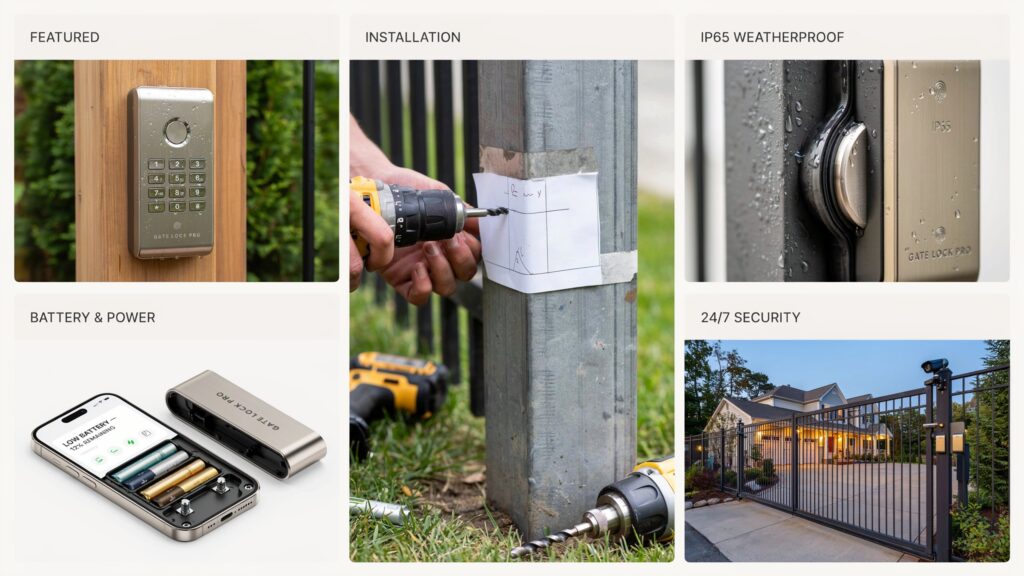
- Measure and mark: Tape the drilling template to the gate at the right height and mark the center points.
- Drill the holes: Keep the drill level, using a hole saw for the cylinder and a standard bit for mounting screws.
- Place the gaskets: Align rubber weather seals on both sides — this step alone determines whether the lock stays a true IP68 waterproof outdoor gate lock or not.
- Mount the panels: Connect front and back units, threading the cable carefully so it doesn’t pinch.
- Test alignment: Manually turn the lock before final tightening to confirm the deadbolt slides smoothly into the strike plate.
- Power up: Insert batteries, seal the compartment, and sync to the smartphone app.
Common Installation Mistakes to Avoid
- Skipping the weather seals — this alone can undo the lock’s entire IP68 waterproof outdoor gate lock rating.
- Over-tightening mounting screws, which can warp internal mechanics or pinch the weatherstripping.
- Ignoring gate sag, which forces the deadbolt to jam against a misaligned strike plate over time.
Pro Tips for High-Security Gates
For open-bar or chain-link gates, welding a steel lock box onto the frame gives the smart lock a solid surface to mount against. Adding a gate closer also prevents repeated slamming, which loosens hardware faster than normal wear.
Proper installation directly protects long-term performance, which connects closely to how weather and daily use affect the lock’s security features over time.
Short Summary:
Installing a weatherproof gate lock takes matching the mount to wood, vinyl, aluminum, or steel, then following six simple steps — measuring, drilling, sealing, mounting, testing alignment, and powering up. Skipping weather seals or ignoring gate sag are the most common reasons an otherwise solid double sided smart gate lock fails early.
Security Beyond the Hardware: Protecting Your Perimeter
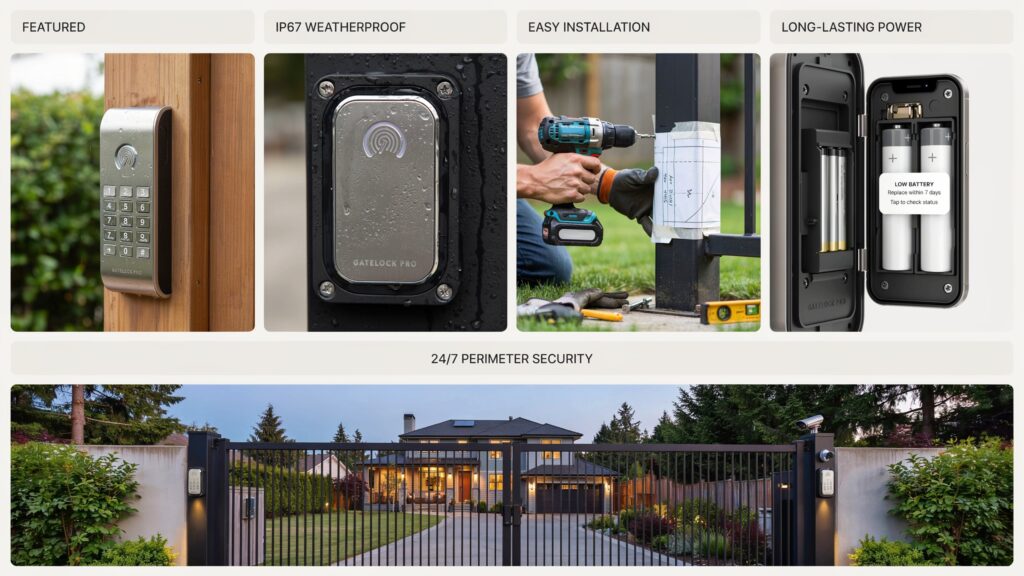
A weatherproof smart lock for outdoor gate use protects more than the gate itself — it closes access gaps that a standard deadbolt leaves wide open and ties into your entire smart home security setup.
Weatherproofing keeps the lock alive; these next features decide how well it actually keeps intruders out.
Stopping the Reach-Over Bypass
Open-bar and low fences share one common flaw: anyone can reach over the top and manually turn a standard interior thumbturn. A double sided smart gate lock removes that manual lever completely, requiring biometric, keypad, or app authentication on both sides — so reaching over the fence accomplishes nothing.
Access Control That Works While You’re Away
- Instant auto-locking: The gate secures itself the moment it swings shut, removing any chance of it being left open by accident.
- Remote monitoring: Check live gate status from anywhere using a smartphone.
- Activity logs: See exactly who entered, when, and which code was used, with real-time alerts for specific access events.
Connecting to Your Wider Smart Home System
A gate lock works best when it’s part of something bigger, not running on its own. Linking it to your broader smart home security for perimeter gate setup means an unlocked gate can automatically trigger exterior cameras to start recording or turn on driveway floodlights — turning one entry point into part of a coordinated security layer. If you’re building this kind of integrated setup, our roundup of smart door locks with built-in cameras shows how combining locking and monitoring in one device simplifies this even further.
This kind of layered protection matters even more once daily wear and seasonal weather start affecting the lock, which is why regular maintenance plays a direct role in keeping these security features working long-term.
Short Summary:
Real gate security goes beyond weatherproofing. A double sided smart gate lock blocks reach-over bypasses, while auto-locking, remote monitoring, and activity logs add active protection. Connecting the lock to a wider smart home security system turns a single gate into part of a full perimeter defense.
Applications of Veeno Smart Gate Lock Systems
Veeno smart gate lock systems are built to secure a wide range of property types — from residential driveways to commercial perimeters — anywhere a standard indoor lock simply isn’t built to last.
The value of a weatherproof smart lock for outdoor gate use becomes clearest once you look at where it actually gets installed, since each setting brings its own access and durability demands.
Residential Driveway and Backyard Gates
Homeowners use Veeno smart gate lock systems to secure driveway entrances and backyard fences without running new wiring across the yard. A double sided smart gate lock here means kids, guests, and delivery drivers can all get temporary access without a physical key ever changing hands.
Pool and Backyard Enclosures
Pool gates face constant humidity and chlorine exposure, which wears down standard hardware fast. A corrosion resistant gate smart lock handles this environment well, while auto-locking ensures the gate secures itself immediately after each use — an important safety layer for households with young children.
Farm and Rural Perimeter Gates
Farm gates often sit far from the main house, with no nearby power source. Battery-powered systems with long battery life outdoor smart lock performance make these gates practical to secure, letting owners check gate status remotely instead of driving out to inspect it manually.
Multi-Unit and Community Properties
Shared driveways, community pools, and rental properties benefit from activity logs and access control, since property managers need to track exactly who enters and when, without managing physical keys for dozens of residents.
Commercial and Storage Yard Gates
Storage yards and small commercial lots use heavy duty weatherproof smart deadbolt systems on steel or chain-link gates, where reach-over bypass risks are higher and 24/7 reliability matters most.
Seeing how these systems perform across different environments naturally leads into comparing specific Veeno models side by side, based on which features matter most for each use case.
Short Summary:
Veeno smart gate lock systems fit residential driveways, pool enclosures, farm perimeters, multi-unit properties, and commercial yards. Each setting relies on different strengths — corrosion resistance for pools, long battery life for rural gates, and double-sided access control for shared or high-traffic properties.
Caring for Your Weatherproof Smart Lock for Outdoor Gate
A weatherproof smart lock for outdoor gate lasts longest with a few minutes of seasonal upkeep — checking alignment, cleaning the sensor, and swapping batteries before winter hits, rather than waiting for something to fail.
Even a heavy duty weatherproof smart deadbolt built for harsh conditions still deals with daily wear, so a little routine care goes a long way toward avoiding an unexpected lockout.
Seasonal Checks for Maximum Lifespan
- Check gate alignment: Wood warps with rain, metal expands in heat — either can throw off the strike plate. A misaligned gate forces the motor to work harder, draining the battery faster.
- Inspect the seals: Look at rubber gaskets and mounting screws before rainy season or winter freezes to confirm the lock still performs as a true IP68 waterproof outdoor gate lock.
Routine Maintenance Habits
- Keep it clean: Wipe the keypad and fingerprint scanner with a soft, damp cloth — avoid harsh chemicals that strip the coating on a corrosion resistant gate smart lock.
- Swap batteries proactively: Replace batteries right before winter, since cold weather saps power fast; lithium batteries hold up better than alkaline for long battery life outdoor smart lock performance.
- Update the firmware: Regular app updates patch bugs, improve efficiency, and keep smart home security for perimeter gates protected against new vulnerabilities.
Troubleshooting Common Issues
- Sticky deadbolt: Use dry Teflon spray or graphite powder — never WD-40, which attracts dirt and worsens jamming over time.
- Unresponsive fingerprint scanner: Usually caused by a dirty sensor or wet fingers; a quick dry wipe often solves it.
- Frequent offline alerts: Often a Wi-Fi range issue — moving the indoor gateway closer to the gate usually restores a stable connection.
This kind of upkeep connects back to something simpler — buying solid hardware to begin with, since quality builds rarely need much fixing down the line.
Short Summary:
Maintaining a weatherproof gate lock takes seasonal alignment checks, clean sensors, proactive lithium battery swaps, and firmware updates. Simple fixes like dry lubricant for a sticky deadbolt or repositioning the Wi-Fi gateway solve most common issues without needing a technician.
Conclusion
A gate is only as secure as the weakest part of it, and for most homeowners, that weak point is a lock never built for open-air exposure. The right IP rating, sealed build, and reliable power turn a vulnerable entry point into a dependable one. If you’re ready to explore your options further, our full collection of smart lock guides and reviews covers everything from installation to troubleshooting. Before your next storm or hard freeze hits, take a moment to check — is your gate actually protected, or just hoping for good weather?
FAQs
1. Can I put a smart lock on a gate?
Yes, a weatherproof smart lock for outdoor gate use is designed specifically for open-air exposure, unlike standard door locks.
2. What is the best lock for an external gate?
A double sided smart gate lock with an IP67 or IP68 rating offers the strongest protection for fully exposed gates.
3. Are smart locks weatherproof?
Not all of them — only models with a genuine IP67/IP68 rating and sealed housing qualify as truly weatherproof.
4. What is the best smart padlock for outdoor use?
Look for an outdoor smart padlock IP67 rating paired with corrosion-resistant materials and long battery life for reliable daily use.
5. Do outdoor smart locks work well in the rain?
Yes, if they carry an IP67 or IP68 rating — anything lower risks water reaching internal components during heavy storms.
6. How long do batteries last in an outdoor smart lock?
A quality long battery life outdoor smart lock typically lasts 6–12 months, longer with lithium batteries in extreme temperatures.
7. Is a double-sided lock necessary for gates?
Yes — it prevents intruders from reaching over open-bar or low fences to bypass a standard interior thumbturn.
Written by M. Bilal
M. Bilal holds a Bachelor’s degree in Criminology and is the founder of CrimTechHub, where he covers home security, smart locks, and access control technology for a US audience. His background in crime prevention shapes how he evaluates security hardware — looking beyond spec sheets to how a product actually holds up against real-world break-in attempts and everyday wear.
He has spent time testing and reviewing smart lock systems, surveillance equipment, and perimeter security tools, focusing on what genuinely improves home safety rather than what simply looks impressive in marketing material. Every guide on CrimTechHub reflects this same standard: practical, field-informed advice built on criminology principles rather than guesswork.