Introduction
Ever checked your camera app only to find a dead battery — right when you needed the footage most? It’s one of the most frustrating moments for any homeowner, and it usually leads to the same question: how much sunlight does a solar security camera really need?
The truth is, most people install these cameras expecting them to run forever on “free” sun power, without ever checking if the spot they chose gets enough of it. A solar security camera isn’t magic — it depends entirely on consistent sunlight exposure to stay charged and ready.
Get the placement right, and you’ll never think about battery life again. Get it wrong, and you’re left with blind spots exactly when you need protection most.
Table of Contents
How Solar Security Cameras Actually Convert Sunlight Into Power
A solar security camera doesn’t store energy on its own — the panel converts sunlight into electricity and sends it straight to the camera’s built-in rechargeable battery. The panel collects; the battery holds that power for use at night or on cloudy days.
This is why sunlight exposure matters more than sunlight duration alone. A panel angled correctly toward the sun for a few solid hours often charges better than one sitting in bright light all day but facing the wrong direction. Placement and angle affect charging efficiency just as much as how long the sun is out.
Even while the camera is recording or sending alerts, the panel keeps charging in the background. A well-placed solar security camera creates a steady charge-and-use cycle instead of relying on one big daily charge — which is exactly why battery performance rarely drops if the panel gets consistent, direct sunlight.
Most “weak battery” complaints aren’t battery problems at all — they’re charging problems caused by shade, poor angle, or bad mounting position. Once the panel gets proper sun exposure, the battery stays topped up on its own.
The Real Daily Sunlight Requirement (Hours, Not Guesswork)
Most solar security cameras need 4 to 6 hours of direct sunlight per day to fully charge and stay powered around the clock. This is the realistic number to plan around — not the “just place it outside” advice that leaves many homeowners frustrated with a dead camera by evening.
Direct sunlight and indirect light aren’t the same thing, and the difference matters more than most people expect:
- Direct sunlight — unobstructed sun hitting the panel — charges fastest and is what most manufacturers base their battery estimates on.
- Indirect or filtered light (through tree cover, patio roofs, or hazy skies) can still charge the camera, but far slower, often requiring double the exposure time for the same result.
- Fully shaded spots provide little to no meaningful charge, even during long daylight hours.
A camera mounted under a porch overhang might sit in daylight for 10 hours straight but only receive 1–2 usable hours of direct sun — which is why some homeowners feel confused when their “solar” camera still needs manual charging.
The goal isn’t maximum daylight exposure. It’s consistent, unobstructed sun contact during the strongest hours of the day, typically late morning through mid-afternoon. Get that window right, and the camera stays charged without ever thinking about it again.
Direct Sunlight vs. Partial Shade: What Actually Works
Not every camera spot needs perfect, all-day sun — partial shade can still work if the fundamentals are right. Here’s what actually holds up in real-world placements:
- Morning shade, afternoon sun — Works well. Most panels catch enough charge from 3–4 hours of strong afternoon light, even with a shaded morning.
- Dappled shade under trees — Risky. Moving leaf cover breaks up direct exposure throughout the day, often cutting charging efficiency by half or more.
- Partial building shadow for 1–2 hours — Acceptable. A short shadow window (like a roofline or eave) rarely affects overall charging if the rest of the day gets direct sun.
- North-facing placements (in the US) — Poor performer. These spots get mostly indirect light year-round and struggle to hold a steady charge, especially in winter.
- Full shade all day — Won’t work. No amount of daylight hours makes up for zero direct sun contact.
The real test isn’t whether a spot gets “enough light” in general — it’s whether the panel gets a solid, uninterrupted block of direct sun at some point in the day. A camera with 3 clean hours of midday sun will almost always outperform one sitting in bright but scattered light for 8 hours straight.
Seasonal & Weather Factors That Change the Equation
Sunlight isn’t constant throughout the year, and a solar security camera that performs perfectly in July can behave very differently by December. Season and geography change the real-world math behind how much sunlight your camera actually needs.
Winter Sunlight and Shorter Days
Winter cuts daylight hours significantly, and with the sun hanging lower in the sky, even open, unobstructed spots get less direct exposure than usual. Homeowners living in northern states often notice charging slows down during these months, sometimes requiring double the sunlight time to match what summer delivers in half the duration.
Cloudy and Overcast Regions
Cities with frequent cloud cover — parts of the Pacific Northwest, for example — naturally challenge solar charging more than sunnier states like Arizona or Texas. Cloud cover doesn’t block charging completely, but it slows it down significantly, since diffused light carries far less usable energy than direct sun.
Seasonal Sun Angle Changes
As the sun’s position shifts through the year, a spot that gets full sun in summer may fall into shadow by winter, especially near rooflines, trees, or fences. This is a common reason cameras that worked fine for months suddenly start draining faster once the seasons change.
Understanding these shifts helps set realistic expectations instead of assuming something is wrong with the camera itself — most seasonal drops in charge are simply the sun doing less work, not the equipment failing.
Best Camera Placement for Maximum Sun Exposure
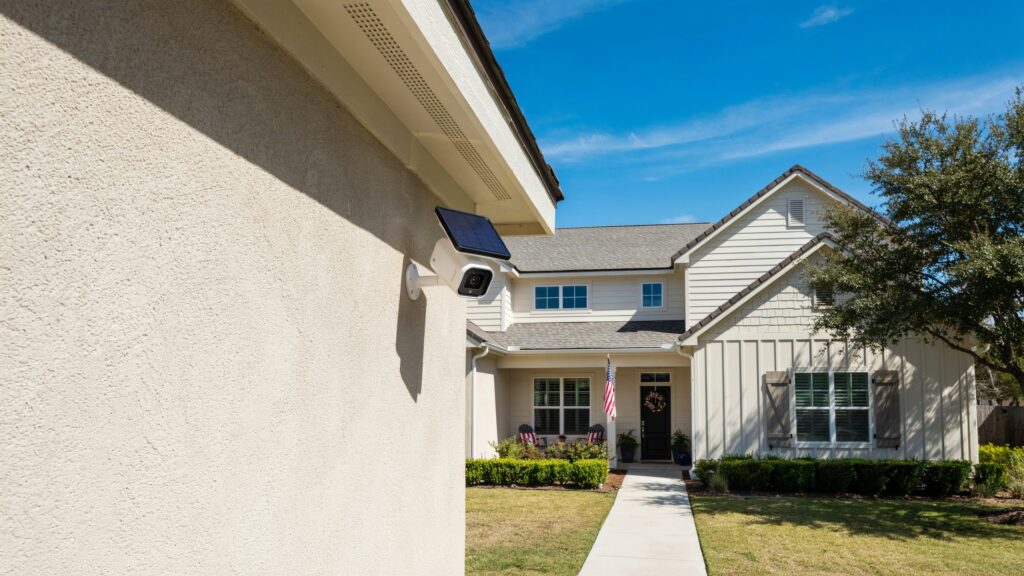
Getting the right amount of sunlight isn’t about luck — it’s about where and how the camera is mounted. A few small adjustments in placement often make the difference between a camera that stays charged effortlessly and one that constantly struggles.
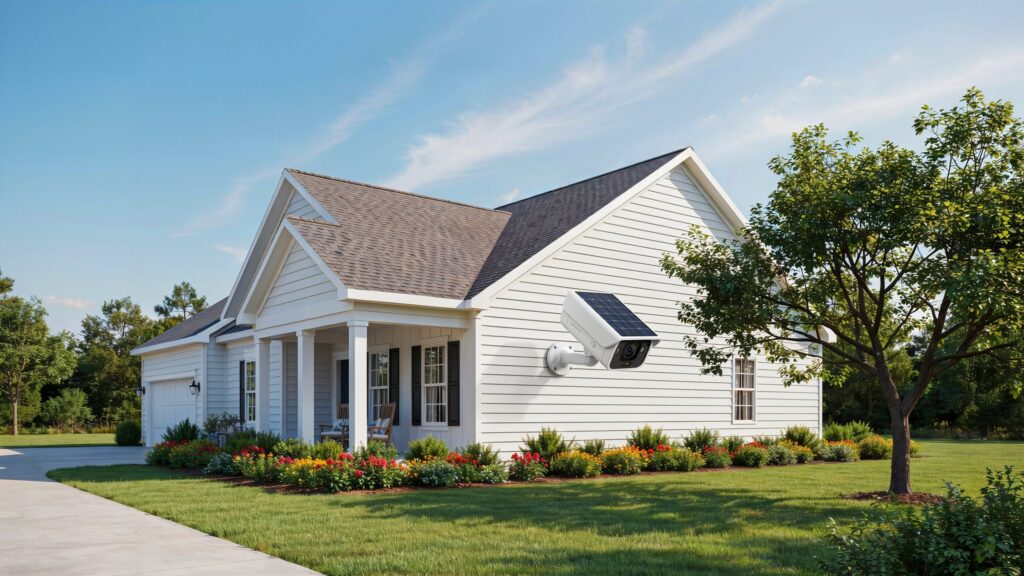
For most homes across the USA, south-facing placement captures the most consistent sunlight throughout the day, since the sun tracks across the southern sky for the majority of daylight hours. East-facing spots pick up strong morning sun, while west-facing areas catch stronger afternoon light — both work well, but south-facing remains the most reliable default when there’s a choice.
Angle matters just as much as direction. Mounting the panel tilted slightly upward, rather than flat against a wall, helps it catch sunlight more directly instead of relying on glancing light throughout the day. Even a small adjustment in tilt can meaningfully improve how much energy the panel pulls in.
Obstructions are where most placement mistakes happen. Common culprits include:
- Overhangs and eaves that block midday sun, the strongest charging window
- Tree branches and growing foliage that create shifting shade as seasons change
- Nearby structures or fences that cast shadows during peak sun hours
- Gutters or roof edges positioned just above the panel, cutting off direct light
Before mounting, it helps to observe the spot at different times of day — ideally over a full afternoon — to see exactly when and how long it receives unobstructed sun. A camera placed even two or three feet away from an obstruction can perform dramatically better than one tucked just behind it.
Warning Signs Your Camera Isn’t Getting Enough Sunlight
A solar security camera rarely fails suddenly — it usually shows small warning signs first. Catching these early saves homeowners from a dead camera at the exact moment they need footage most.
Battery Drain Patterns to Watch
- Charge drops overnight faster than usual — a sign the panel didn’t fully charge during the day
- Battery percentage stalls even in daylight — suggests the panel isn’t getting real direct sun, just ambient light
- Steady decline over several days — points to a placement issue rather than a one-off cloudy day
App Notifications That Signal a Problem
Most camera apps send low-battery alerts, but the pattern matters more than a single warning. Repeated low-battery notifications on sunny days — not just cloudy ones — almost always trace back to shade, wrong angle, or blocked panel exposure rather than a battery defect.
Performance Drops That Point to Sunlight Issues
- Slower motion detection response as the camera conserves power
- Reduced video quality or shorter clip recording to save battery
- Delayed live-view loading when the app tries to wake a low-power camera
If these signs show up consistently, the fix is rarely the equipment — it’s the sunlight reaching it. A quick check of the mounting spot during peak afternoon hours often reveals the real cause before it becomes a bigger problem.
Final Thoughts
A solar security camera only needs one thing to perform well — consistent, direct sunlight in the right spot. Get that right, and battery drain, weak charging, and constant troubleshooting disappear.
Most performance problems trace back to placement, not the camera itself. A shift of a few feet, a better angle, or clearing one shaded branch can turn a struggling camera into one that charges itself reliably, day after day.
Take a moment to check where your camera sits right now — the sun may already be telling you what it needs.
FAQs
Does a solar security camera need direct sunlight?
Yes, most models need 4–6 hours of direct sunlight daily for a full, reliable charge.
Do solar-powered security cameras work at night?
Yes, they run on stored battery power at night, using the charge collected during the day.
What are the disadvantages of solar cameras?
Performance can drop in shaded spots, cloudy regions, or short winter days without enough direct sun.
Do solar cameras work in cloudy weather?
Yes, but charging slows down significantly since diffused light carries far less usable energy than direct sun.
Do solar cameras work in winter?
Yes, though shorter days and a lower sun angle often mean slower charging than in summer months.
What is the 20% rule for solar?
It refers to keeping a battery’s charge above 20% to protect long-term battery health and performance.
What did Elon Musk say about solar energy?
He’s spoken about solar power as key to a sustainable energy future, especially alongside battery storage.
Does a 400W solar panel produce 400W?
Rarely at full capacity — real output depends on sunlight intensity, angle, and weather conditions.