Introduction
Have you ever pulled back your curtains and noticed a camera lens quietly pointed straight at your window?That unsettled feeling hits more homeowners than you’d expect. As outdoor security systems become more popular, learning how to block a neighbor’s security camera has become a real concern for anyone who just wants their backyard to feel private again.
It’s not about overreacting. Your home should be the one place where you can relax without wondering who’s watching. When a camera drifts into your yard, patio, or windows, it can make even your own space feel exposed.
The good news? You have real, legal options, no confrontation needed. This guide shows you exactly how to handle it calmly and confidently.
Table of Contents
Is It Legal for a Neighbor’s Camera to Face Your Property?
The first question most homeowners ask is simple: can my neighbor actually point a camera at my house? The honest answer is, it depends — but understanding the basic legal framework will help you know where you stand before you decide on your next move.
In most of the United States, courts and privacy laws are built around something called the “reasonable expectation of privacy.” This means the law protects you in places where you’d naturally expect privacy, while spaces visible from the street generally don’t carry the same protection. In simple terms:
- Protected spaces: Inside your home, bathrooms, bedrooms, and areas shielded by a fence or wall
- Not typically protected: Front yards, driveways, sidewalks, and anything easily visible from a public street
A camera aimed at your driveway from next door typically falls within legal limits. A camera angled directly into your bedroom window is a different story entirely.
Here’s where it gets more nuanced: exterior surveillance laws vary significantly from state to state, especially when audio is involved:
- Video-only recording: Generally allowed in most outdoor, publicly visible areas
- Audio recording: Treated much more strictly, since many states require consent from all parties before a conversation can legally be recorded
- Local ordinances: Some cities and HOAs add their own placement and notice requirements on top of state law
That’s an important distinction — a camera that only captures video footage of your yard is treated very differently under the law than one that’s also picking up your conversations without your knowledge.
There’s also a difference between a camera simply existing in view of your property and a camera that appears deliberately aimed at private areas:
- A doorbell camera catching a wide angle of the street
- A security camera clearly repositioned to stare into your living room or bedroom window
- A camera mounted specifically to monitor your backyard activity rather than the neighbor’s own property
Courts tend to look at intent and placement, not just the fact that a camera exists nearby.
Because these laws shift by state and even by local ordinance, it’s worth taking a few minutes to check your specific state’s surveillance and privacy statutes before assuming your neighbor is in the wrong — or before assuming you have no options. Knowing where the legal line actually sits puts you in a much stronger position, whether you end up having a calm conversation with your neighbor or looking into physical privacy solutions on your own property.
How to Confirm the Camera Is Actually Pointed at You
Before you march over to your neighbor’s door or start researching how to block a neighbor’s security camera, it’s worth slowing down for a moment. Cameras look intimidating from a distance, and it’s easy to assume the worst the second you spot a lens facing your direction. But not every camera near your property line is actually watching you — some are simply positioned to cover a driveway, a front porch, or a shared walkway, and your yard just happens to fall within the edge of that view.
The smartest first move is observation, not confrontation. Try checking the camera’s angle from different spots — your yard, your windows, your porch — at various times throughout the day.Pay attention to where the lens is actually facing, not just where it’s mounted. A camera can be attached to a fence that borders your property yet still be angled toward the neighbor’s own driveway or front door.What the lens actually captures matters far more than where the camera is mounted.
Signs a camera is genuinely aimed at your space
A few clear indicators can help you tell the difference between a camera that happens to be nearby and one that’s specifically monitoring your property:
- The lens is tilted noticeably toward your windows, patio, or backyard rather than the neighbor’s own entryway
- The camera has been repositioned or adjusted after a disagreement, argument, or complaint between neighbors
- Motion-activated lights or camera indicators consistently trigger when you’re in your own yard, not theirs
- The mounting angle covers areas with no logical connection to the neighbor’s property, like your bedroom window or backyard pool
If you notice one or two of these signs, it doesn’t automatically mean something malicious is happening. Sometimes a camera is simply mounted poorly, or the homeowner adjusted it for a delivery issue and never realized the new angle overlaps into your space. This is exactly why talking calmly, rather than assuming the worst, tends to resolve most situations faster than jumping straight to legal threats or drastic action. A clear head and a little observation go a long way before deciding on your next step.
Talking to Your Neighbor First: The Simplest Fix
Once you’ve confirmed a camera really is pointed at your space, the next step isn’t a lawyer or a formal complaint — it’s a conversation.It might sound too easy, but a calm, friendly conversation clears up most of these situations faster than anything else on this list. Most people don’t install a camera to spy on their neighbors. They’re usually just trying to protect their own home, and they genuinely haven’t noticed that the angle drifts into your yard or your window.
Approach the conversation the same way you’d want someone to approach you. Mention what you’ve noticed, ask if the camera could be adjusted slightly, and explain why it matters to you — whether that’s your kids playing in the backyard, privacy while relaxing on your patio, or simply feeling comfortable in your own home. Framing it as a shared concern rather than an accusation makes a real difference. Something as simple as, “Hey, I noticed your camera seems to catch our backyard too, would you mind adjusting the angle a bit?” tends to land far better than demanding they take it down entirely.
Real life examples back this up. Many homeowners who’ve dealt with a neighbor’s camera pointed at their house say the issue was resolved within a single conversation, often the same day. The neighbor either shifts the camera angle, adds a privacy zone through their app’s masking settings, or explains the original reasoning, which usually clears up the misunderstanding completely. Compare that to skipping straight to a formal complaint or confrontation, which can turn a simple fix into a lasting neighborhood dispute over something that started as a five-minute conversation.
Keeping your tone respectful matters just as much as what you say. Avoid accusing your neighbor of spying or invading your privacy right out of the gate, even if that’s how it feels. People tend to get defensive when they feel attacked, which makes them far less willing to cooperate. A relaxed, non-confrontational approach keeps the door open for an easy resolution and preserves the relationship you’ll likely need to maintain for years to come, since neighbors, unlike most disputes, aren’t something you can simply walk away from.
Physical Ways to Block a Camera’s View on Your Own Property
If a conversation with your neighbor doesn’t resolve things, or you’d simply rather handle the situation quietly on your own side of the fence, there are plenty of effective, completely legal ways to reclaim your privacy. The beauty of this approach is that it doesn’t require confrontation at all. You’re not touching their camera or asking them to change anything — you’re just controlling what’s visible from your own property, which is always within your rights.
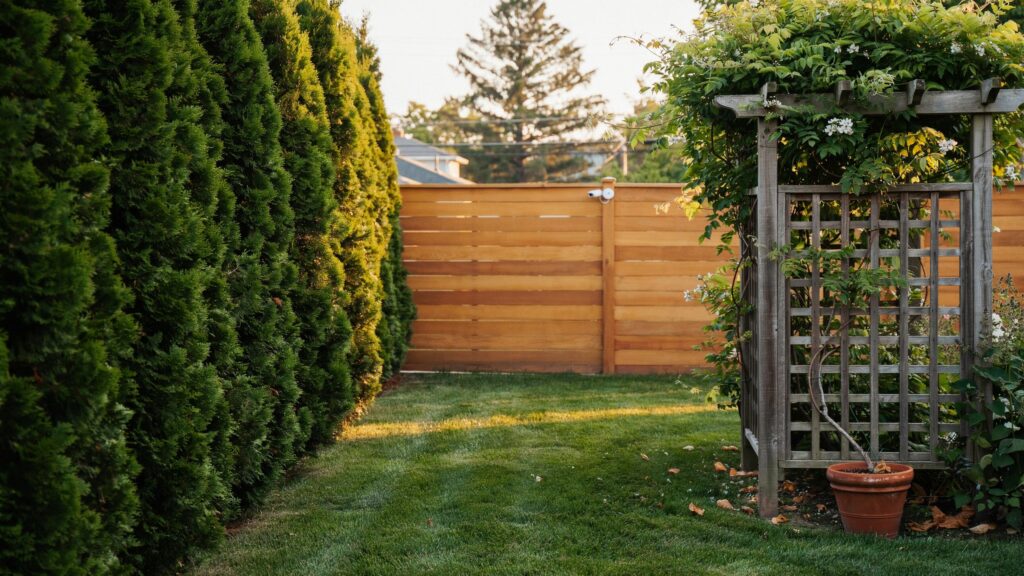
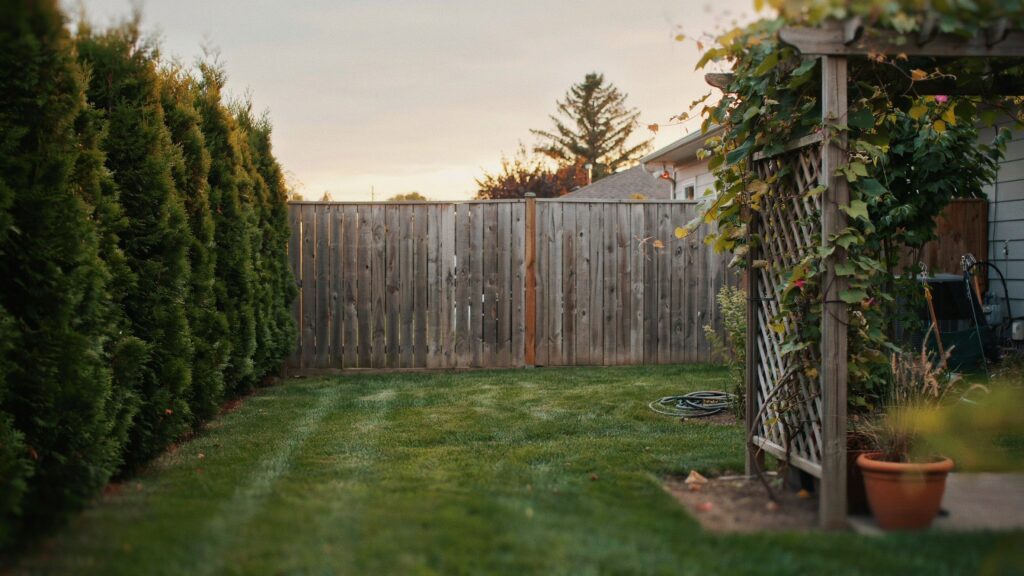
Privacy fencing is usually the most reliable long-term solution. A solid wood, vinyl, or composite fence tall enough to block the camera’s direct line of sight can eliminate the issue entirely, especially for ground-level angles aimed at a backyard or patio. For camera angles positioned higher up, like those mounted on a second story or aimed downward from a roofline, fence extensions or lattice topper panels add extra height without requiring a full rebuild.
Landscaping is a softer, more natural option that blends privacy with curb appeal. Strategic planting doesn’t just block a camera’s view, it also adds long-term value to your yard.
Best privacy plants and fencing options
- Arborvitae or Leyland cypress for fast-growing, year-round dense coverage
- Bamboo (clumping variety) for quick height and a natural screening effect
- Tall ornamental grasses for lower-cost, softer boundary lines
- Lattice fence toppers to extend existing fence height affordably
- Retractable outdoor privacy screens for flexible, adjustable coverage
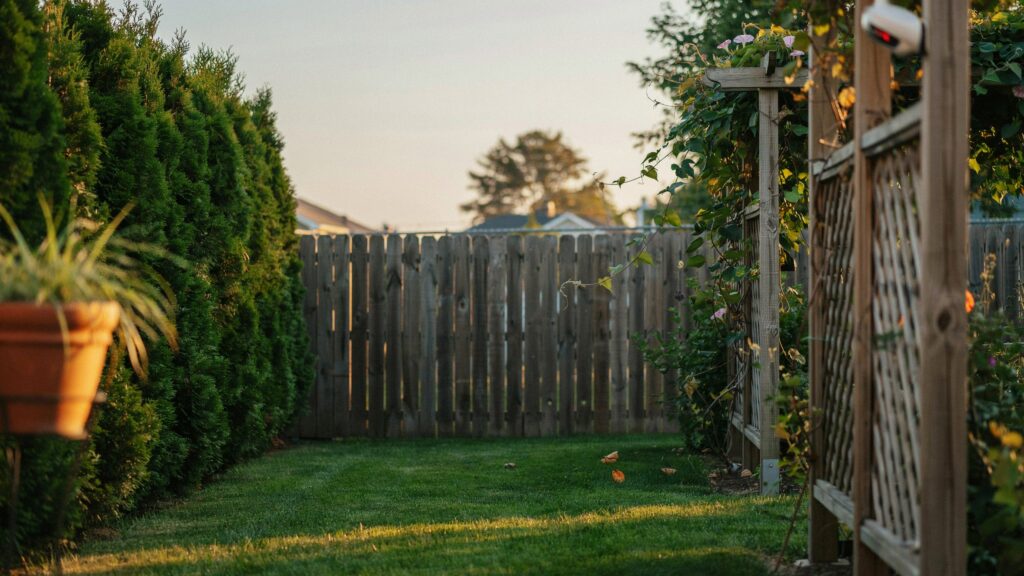
Outdoor curtains and shade screens work especially well for patios, decks, or pool areas where a permanent fence isn’t practical. Weatherproof outdoor curtains can be drawn during the times you’re actually using the space, giving you privacy exactly when you need it without a permanent structural change. Trellises covered with climbing vines, like clematis or jasmine, offer a similar effect while adding natural beauty to the yard.
The real advantage of these physical privacy solutions is that they put the control back in your hands. You’re not depending on your neighbor’s cooperation, and you’re not risking any legal gray area, since blocking your own view with your own landscaping or fencing is always a step you’re entitled to take.
When to Involve a Homeowners Association, Landlord, or Local Authority
If a friendly conversation and physical privacy solutions haven’t fixed the problem, or your neighbor refuses to cooperate at all, it may be time to escalate through the right official channels. This step isn’t about starting a war with your neighbor — it’s about knowing which resources exist when a direct approach doesn’t work.
When to contact your HOA
- Your community has specific rules about camera placement or exterior surveillance equipment
- The camera violates a documented HOA privacy or architectural guideline
- Previous informal requests to your neighbor were ignored
When to involve your landlord (if you’re renting)
- The camera belongs to another tenant or unit in a shared building
- The camera captures shared hallways, parking areas, or entrances without proper notice
- Lease terms include language about tenant privacy or camera restrictions
When to contact local authorities or city code enforcement
- The camera includes audio recording without consent, which may violate state wiretapping laws
- The camera is clearly and persistently aimed into private spaces like bedrooms or bathrooms
- You suspect harassment or stalking rather than a simple placement misunderstanding
Non-legal mediation options worth trying first
- Community mediation services, often free through local city or county programs
- A written, polite letter documenting your concern before pursuing formal complaints
- HOA-facilitated neighbor discussions, if your community offers this service
Escalation should always be the last resort, not the first reaction. Most disputes over a neighbor’s camera never need to reach this level, but knowing these options exist gives you peace of mind if a calm conversation and privacy upgrades on your own property simply aren’t enough.
What NOT to Do When Dealing With a Neighbor’s Camera
It’s tempting to want a quick, hands-on fix when you feel like you’re being watched. But before you consider tampering with, blocking, or disabling someone else’s security camera, it’s worth understanding that this approach can create far bigger problems than the one you started with. A camera pointed the wrong way is frustrating, but interfering with someone else’s property crosses a legal line that’s rarely worth the risk.
Actions that can get you into legal trouble
- Physically covering, spray-painting, or obstructing a neighbor’s camera
- Using laser pointers, infrared devices, or jamming tools to disable the feed
- Damaging, removing, or relocating a camera without permission
- Hacking into or tampering with someone else’s home security system
Tampering with another person’s security equipment can be treated as criminal mischief, vandalism, or even a form of harassment, depending on your state. What feels like a reasonable response to an invasion of privacy can quickly turn you into the one facing legal consequences, since the camera itself is legally the other person’s property, regardless of where it’s pointed.
Why restraint protects you better than retaliation
Reacting emotionally in the moment is understandable, especially if you feel your privacy has genuinely been violated. But taking matters into your own hands almost always escalates the situation rather than resolving it. A damaged camera can lead to police reports, insurance claims, or even a lawsuit, turning a simple neighborhood disagreement into a drawn-out legal mess that affects both households for months or years.
The stronger, safer path is sticking to the legal and practical solutions already covered, having a calm conversation, adjusting your own landscaping or fencing, and involving an HOA or local authority only when necessary. These options protect your privacy just as effectively, without putting your own legal standing at risk.
Final Thoughts
Dealing with a neighbor’s security camera pointed at your property doesn’t have to turn into a legal battle. Start by confirming the camera’s actual angle, then have a calm, direct conversation, since most cases resolve right there. If not, privacy fencing, landscaping, or outdoor screens give you full control without needing your neighbor’s cooperation. Save HOA involvement or local authorities for cases that don’t resolve on their own, and always avoid tampering with someone else’s camera, no matter how frustrating the situation feels.
With the right approach, you can protect your privacy, stay within the law, and keep peace with your neighbor at the same time.
FAQs
Q1: How to disrupt neighbor security camera?
Disrupting someone else’s camera can be considered tampering or criminal mischief in most states, so it’s better to use legal privacy solutions like fencing or landscaping instead.
Q2: What kind of light interferes with security cameras?
Strong infrared or direct light sources can cause glare on a camera lens, but intentionally aiming light at a neighbor’s device to disable it can carry legal risk.
Q3: Do security camera jammers work?
Signal jammers are illegal to use in the United States under FCC regulations and can result in serious fines, even if marketed online.
Q4: How can I block my neighbor’s security camera?
The safest and fully legal option is blocking the view from your own property using a privacy fence, tall plants, or an outdoor screen.
Q5: What material blocks cameras?
Solid fencing, dense landscaping, and opaque outdoor privacy screens are the most effective materials for blocking a camera’s line of sight.
Q6: Can magnets interfere with cameras?
Standard security cameras use digital sensors, not magnetic components, so magnets have no real effect on how they record.
Q7: What will blind a security camera?
Nothing should be used to intentionally blind or disable another person’s camera, since this can be treated as property damage or tampering under the law.
Q8: What magnet can take off security tags?
This refers to retail anti-theft tags, not home security cameras, and removing them without authorization is illegal.